LaunchReel AI / Code-generated video
Code-Generated Video for Launch Films
A launch film drawn from a plan by code, not painted by a model: your real screens, exact text, and one shot redrawn at a time.
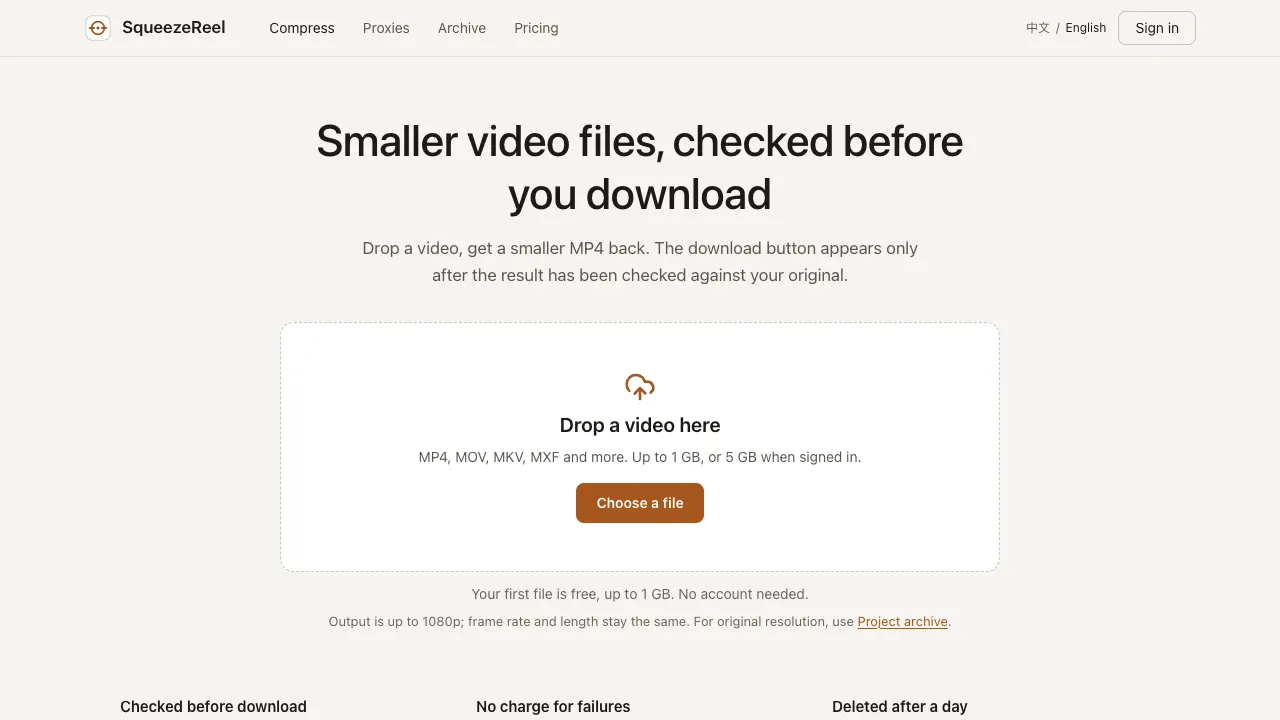
Before · squeezereel.com
After · the film LaunchReel made from it
SqueezeReel is a separate video-compression product by the same studio; this launch video was made for it. squeezereel.com
$39 buys the Starter pack: one launch video (the brief, the storyboard and a film of about 30 seconds in 16:9 from your real screenshots), a clean 1080p export, and 10 credits left for shot changes.
One-time $39, no subscription. Stripe Checkout asks for your email. Nothing runs before you pay; after payment you press Start and the brief, the storyboard and the film follow by themselves.
Code-generated video is video drawn by a program from a written plan, not painted pixel by pixel by a diffusion model. LaunchReel AI makes one kind: the product launch film. It writes a storyboard from your site, then draws every shot from named motion components and your real screens, so text stays crisp and one shot can be redrawn alone.
By the LaunchReel team
See what we made
Made with LaunchReel for ReadVideo and SqueezeReel, two separate products by the same studio. Watch the films, then try your own site.
ReadVideo
Own product · 2026-10-10 · 31 seconds · English on-screen text
1280 × 720 · 16:9 · No audio track
ReadVideo: click the text to jump back to the matching moment in the video.
LaunchReel preview
Make a video for my siteWhat is code-generated video?
A pixel-generation model starts from noise and paints every frame of a clip. Code-generated video starts from a plan. The plan lists what is in each shot (type, shapes, screens, a camera), where each piece sits and how it moves and eases over time. A renderer then draws any frame of that plan on demand.
That has three consequences. Text is real type, so a word is spelled the way you wrote it. The same plan gives the same frames every time. And a plan can be edited: change one line of it and only that part of the film is drawn again.
How the two differ
| Aspect | Painted by a generation model | Drawn from code |
|---|---|---|
| Text on screen | Can warp or misspell, most of all small type | Real type, exact as written |
| Your product's screens | Imitated from a description | Your real screenshots, never invented |
| Changing one thing | Generate the clip again | Redraw only the shot that changed |
| The same input twice | A different clip | The same frames |
| Best at | Footage, people, places, photoreal scenes | Interfaces, type, diagrams, motion graphics |
Why does code-generated video suit a launch film?
A launch film is mostly words, interface and one or two numbers, shown to someone who is scrolling with the sound off. Those are the things a painted clip does worst. A wrong letter in your product name, or a button that does not exist, costs more than a plain shot ever saves.
A launch film also gets changed. Between the first cut and launch day the tagline moves, a screenshot is replaced and the length is trimmed. When the film is a plan, each of those is a small edit to one shot, not a new roll of the dice.
How does LaunchReel make a launch film this way?
The pipeline has six stages, listed below. The first two are plain text, so you can read what the film will say before a frame is drawn.
The motion layer is open. Its components can be browsed on compreel.com/motion and the package is MIT licensed on npm as @launchreel/motion-kit.
Where can I see films made this way?
The films above are our own, made for ReadVideo and SqueezeReel. Films that customers chose to share are in the gallery, and anyone can start a new project from one of them as a template: its structure, pacing and style, made with their own product. More are on the examples page.
Can I change one shot without redrawing the film?
Yes. Next to the timeline there is a chat: say what to change and only that shot is rewritten and redrawn. You can also edit a shot directly in the Storyboard view. A shot change costs a small, fixed number of credits, taken when the change lands, and every version of a shot is kept so you can go back.
Changes to the narration or the music re-mix the sound and leave the picture alone.
What do I get out of it?
A 16:9 MP4 in 1080p or 4K with the captions burned in, an .srt file, and short cuts of 5 to 10 seconds in 16:9, 9:16 and 1:1. The Pro tier adds an After Effects project: one composition per shot with editable text and shapes and their keyframes, so a motion designer can pick the film up where the code stopped.
From brief to film in six stages
- 01
Brief
LaunchReel reads your site (the home page and up to three inner pages) and answers six questions about the product, each with the page it came from. From the answers it writes a brief: audience, selling points, tone and which screens to show.
- 02
Storyboard
Each shot gets a duration, its on-screen words and the motion it will use. A 30-second film runs to about seven shots. The storyboard is shown as it is written, and you can change a line in it or ask in the chat.
- 03
Motion components
Every shot is built from a vocabulary of named components: transitions, title treatments, device frames, diagrams and typing effects, each with set timing and easing. A shot picks components by name, so the film moves the way a motion designer would specify it.
- 04
Music grid
The film carries a beat grid taken from the tempo of its music bed. Components that can land on a beat, such as title arrivals and cuts, are placed on beat addresses on that grid, and a rhythm check flags a landing that sits off the beat. The check is advice only.
- 05
Narration
Each shot has one or two spoken lines in the film's language, English or Chinese. A line is voiced with the lines on either side as context, so the delivery runs on from shot to shot, then fitted to its shot and mixed with the music at one loudness.
- 06
Render
A headless browser draws the frames from the plan and ffmpeg encodes them into an MP4 with the captions burned in. No diffusion model paints any part of the picture.
Who it is for
- Founders and small teams launching a software or web product who need a launch film this week.
- Developer-tool and open-source maintainers whose commands and numbers must be exact on screen.
- Teams that will revise the film several times before launch day.
- Motion designers who would rather start from a project than from a blank timeline.
Who it is not for
- Live-action footage of people, places or hands.
- Photoreal scenes or 3D product renders.
- Films that need a screen that does not exist: the engine never invents an interface.
- Long-form or episodic video: a film is about 30 seconds, with 60 seconds available.
Questions people ask
Is code-generated video the same as AI video?
Not quite. AI writes the plan: a language model reads your site and writes the brief and the storyboard. But no model paints the frames; code draws them. "AI video" usually means pixels generated by a diffusion model, which is the other approach.
Will the text in my film be exactly what I wrote?
Yes. Text is set as real type, so it matches the storyboard character for character. Read it in the storyboard and fix any line in the chat.
Does it invent screens or features?
No. Screens come from your real screenshots and the words from your site. When the site does not say something, the brief says so instead of making it up.
Which languages can the narration speak?
English and Chinese today. Each shot has one or two lines, in the film's language, and narration can be switched off.
Can a motion designer continue in After Effects?
Yes, with the After Effects project from the Pro tier: one composition per shot, editable text and shapes with their keyframes, the narration and the rendered film as a guide.
Is the motion engine open?
The motion layer is MIT licensed on npm as @launchreel/motion-kit, and its components are shown on compreel.com/motion. LaunchReel itself is a hosted product.
Try it on your own site
Paste your URL to see your plan and the packs. The brief, the storyboard and a 720p copy to keep come with the project. See pricing.